

M1 Time Frame Trading Strategy: Scalping Setup, Risk Management & Entry Rules
Master M1 time frame trading strategy with scalping setups, risk management, VWAP, EMA, and precision execution for consistent 1-minute trades.

The M1 (1-Minute) Chart: Precision, Speed & Tactical Execution
One of the fastest and most sensitive time frames for trading is the M1 (1-minute) time frame. Each represents a single minute of trading, and traders make their choices in the blink of an eye based on a few seconds' worth of market momentum, liquidity changes, microstructure, and volatility.
For those who seek disciplined trading, M1 can offer a wealth of opportunities to trade with precise entries, low risk, and quick capital turnaround. It can be a source of overtrading, emotional fatigue, spread-related losses, and inconsistency for undisciplined traders.
A profitable M1 time frame trading strategy does not make a lot of trades; it captures repeatable trade patterns using market structure, session timing, execution quality, and strict risk controls.
Unlike higher timeframes, where broader trends dominate, M1 magnifies:
- Spread costs
- Slippage
- False breakouts
- Latency issues
- Emotional mistakes
- Broker execution speed
- Commission structure
- Spread efficiency
- Session volatility
- Psychological consistency
Key Takeaways
- The main focus of M1 trading is scalping and precision execution.
- Higher time frame bias (M5/M15) greatly enhances signal quality.
- The session that you pick can make a big difference—London and New York are usually the most liquid sessions.
- The actual cost of achieving wins is more important than many traders realize, alongside risk management and execution costs.
- Sometimes, less is more when using indicators like VWAP, EMA, volume, and market structure.
- Fixed-pip stops are not as good as volatility-adjusted ones.
- Profitability should be judged based on the expectancy, not the risk-reward ratio.
- Spreads, slippages, and commissions can be the difference between a profitable M1 and one that loses money.
- Optimization is essential, and trading journals and analytics software are key.
- It is often better for a beginner to learn M5 first, before moving on to M1.
Introduction to M1 Time Frame Trading
M1 time frame trading is the process of making trades on a one-minute chart, recognizing that shorter time frames can yield smaller price movements. This style is often used for scalping, with holding periods ranging from seconds to minutes.
Since M1 is the shortest time frame, traders need to differentiate between the following:
Productive Movement:
- Institutional momentum
- Session breakouts
- Trend continuation
- Liquidity sweeps
- Random price spikes
- Spread manipulation
- Choppy consolidation
- Low-volume false signals
Why Traders Use the M1 Time Frame
Advantages:
- Frequent Opportunities - Setups occur frequently during active sessions.
- Precise Entries - Narrower stop-loss zones, more precisely executed trades
- Faster Feedback - Immediate trade outcomes allow for faster data collection.
- Scalability - Multiple edges can add up.
Challenges:
- Spread Sensitivity - Transaction costs are more important at smaller time intervals.
- Slippage Risk - Candles may vary in entry/exit precision due to their speed of movement.
- Psychological Fatigue - The lack of time to make decisions causes mental fatigue.
- Overtrading - High frequency is best avoided because it can encourage impulsive entries.
Core Principle: Trade Structure, Not Noise
The worst thing that can happen in M1 trading is to see every candle as an opportunity.
Professional traders use top-down analysis:
Step 1:
Identify higher-time-frame trends using M5 or M15 charts.
Step 2:
Only use the M1 to execute.
Example:
If M5 shows:
- Higher highs
- Bullish VWAP positioning
- Strong session momentum
- Pullback entries
- Liquidity reclaim
- Trend continuation scalps
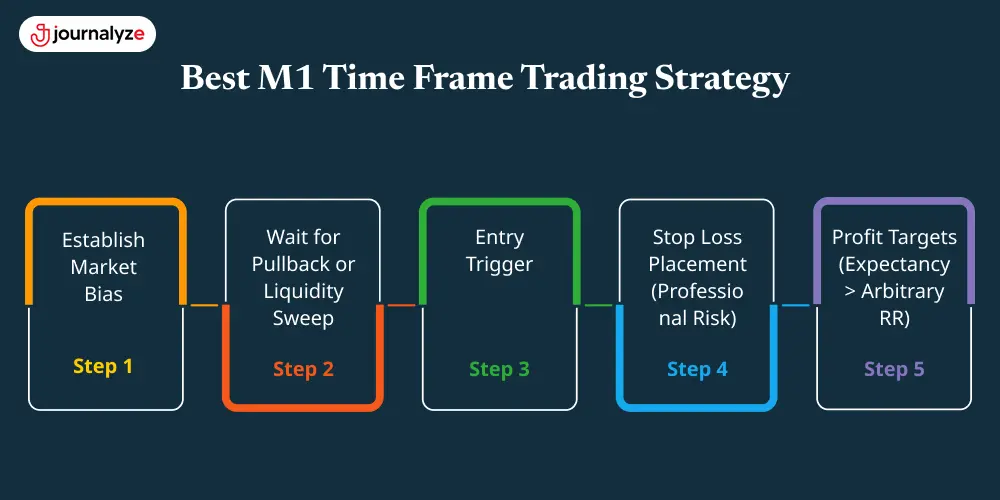
Best M1 Time Frame Trading Strategy (Professional Scalping Framework)
Step 1: Establish Market Bias
Before placing any M1 trade, you should establish directional context with:
- VWAP
- 9 EMA / 20 EMA
- M5 structure
- Session highs/lows
- Key support/resistance
Bullish Conditions:
- Price above VWAP
- 9 EMA above 20 EMA
- M5 higher highs
- Strong buying volume
Bearish Conditions:
- Price below VWAP
- 9 EMA below 20 EMA
- M5 lower lows
- Selling pressure
Step 2: Wait for Pullback or Liquidity Sweep
Avoid chasing extended candles.
Instead, wait for:
- Pullback into VWAP/EMA
- Support/resistance retest
- Stop-hunt wick
- A decrease in volume followed by an increase.
Step 3: Entry Trigger
Buy Setup:
- The overall trend is bullish, with a bias toward higher timeframes.
- Pullback into support
- Bullish engulfing/rejection candle
- RSI above 50
- Volume expansion
Sell Setup:
- Bearish bias
- Pullback into resistance
- Bearish engulfing candle
- RSI below 50
- Selling volume confirmation
Step 4: Stop Loss Placement (Professional Risk)
Avoid arbitrary “3–5 pip” rules.
Instead, use:
Volatility-Based Stop:
- ATR
- Market structure invalidation
- Spread buffer
Formula:
Position Size = Risk Amount / Stop Distance
Example:
$10,000 account 1% risk = $100 5-pip stop = position sized accordingly
This ensures consistency.
Read More: Trading in the Zone: 7 Key Principles Every Consistent Trader Must Master
Step 5: Profit Targets (Expectancy > Arbitrary RR)
Many traders obsess over a 1:2 risk-reward ratio, but M1 profitability depends on expectancy:
Expectancy Formula:
(Win Rate × Average Win) – (Loss Rate × Average Loss)
A strategy with:
- 75% win rate
- 1:1 RR
- 40% win rate
- 1:3 RR
Effective Exit Methods:
- Session liquidity zones
- Partial scaling
- Fixed scalp targets
- Trailing stop behind the structure
Best Indicators for M1 Trading
- VWAP - Best setups: intraday directional bias and institutional context.
- 9 EMA + 20 EMA - Beating 20/50 for lower time accuracy
- RSI - Confirm the signal by momentum—do not buy based solely on the signal.
- Volume - This is important for verifying breakout quality.
- Market Structure - Better than indicator overload in most cases
Indicators should verify, not replace, price action.
Psychology of M1 Trading
Fast trading amplifies emotional weaknesses.
Essential Traits:
- Discipline
- Patience
- Immediate loss acceptance
- No FOMO
- Process over prediction
Key Truth:
Not every candle deserves your capital.
Building a Professional M1 Framework
M1 is sustainable when approached through:
Strategy:
One tested setup
Risk:
Fixed percentage model
Sessions:
Only trade during optimal volatility intervals.
Analytics:
Track:
- Win rate
- Expectancy
- Session performance
- Emotional errors
- Spread impact
M1 vs M5: Which Is Better?
| Feature | M1 | M5 |
| Trade Frequency | Very High | Moderate |
| Noise | High | Lower |
| Precision | Excellent | Good |
| Stress | Very High | Moderate |
| Beginner Suitability | Lower | Higher |
Conclusion
The M1 time frame is not a profitable or dangerous one, but simply unforgiving.
When combined with:
- Structured setups
- Session awareness
- Cost-adjusted execution
- Strict risk controls
- Psychological discipline
- Data-driven review
Trade selectively. Execute systematically. Review relentlessly.
This is how the 1-minute chart turns into a professional trading system.
FAQ: M1 Time Frame Trading Strategy
Is M1 profitable?
Yes—if it's execution, expectancy, and discipline.
Best strategy?
Trend following pullback + liquidity confirmation.
Is M1 better than M5?
The precision is M1; the cleaner structure is M5.
Can beginners use M1?
Potentially—but M5 may help develop basic skills first.
Most important factor?
Risk-adjusted consistency.