

Trading in the Zone: 7 Key Principles Every Consistent Trader Must Master
Master Trading in the Zone with 7 key principles for discipline, risk management, and probabilistic thinking to improve consistency.

Introduction
Many traders think that the key to success is finding the right strategy. Well, there's a great deal more to it than the technical indicators—it's about psychology, discipline, and consistency.
This is the main trading psychology lesson that Mark Douglas teaches in the best trading psychology book, Trading in the Zone.
But no matter how much experience you have or how experienced you are, the emotions, impulsivity, revenge trading, and lack of discipline can ruin performance quicker than a wrong strategy. Successful traders have different thoughts. They have an understanding of probabilities, risk assessment, and emotional control.
We will take a look at each of the 7 key principles from Trading in the Zone, discuss what it means to trade with a probabilistic approach, and explain how traders can utilize a day trading journal or analytics software to achieve repeatable success.
Key Takeaways
- Psychology and discipline are key to successful trading.
- Traders can deal with the uncertainty of trading with the help of probabilistic thinking.
- Emotional trading errors are one of the largest sources of inconsistencies.
- Risk acceptance decreases risk avoidance decision-making.
- Journaling is a way of increasing accountability and quality of execution.
- Consistent traders are more interested in process than perfection.
- Systematic behavior is what brings in long-term profits.
What Is Trading in the Zone?
The Zone is a trading psychology that teaches traders the mindset they need to reach consistent trading.
Rather than focusing on chart patterns or technical indicators, Mark Douglas explains why traders often fail emotionally even when they understand technical analysis correctly.
The book focuses on:
- Emotional discipline
- Risk acceptance
- Probability-based thinking
- Confidence without certainty
- Consistent execution
- Successful traders do not aim to predict the market perfectly.
- They develop consistency in their efforts in the absence of certainty.
Why Trading Psychology Matters More Than Strategy
There are traders out there who have spent years looking for other indicators but haven't paid attention to their own emotions.
However, the real problems usually come from:
- Fear of losing
- Overconfidence after wins
- Revenge trading
- Hesitation during valid setups
- Exiting trades too early
- Ignoring stop losses
A disciplined approach to your investing ensures stability in various scenarios.
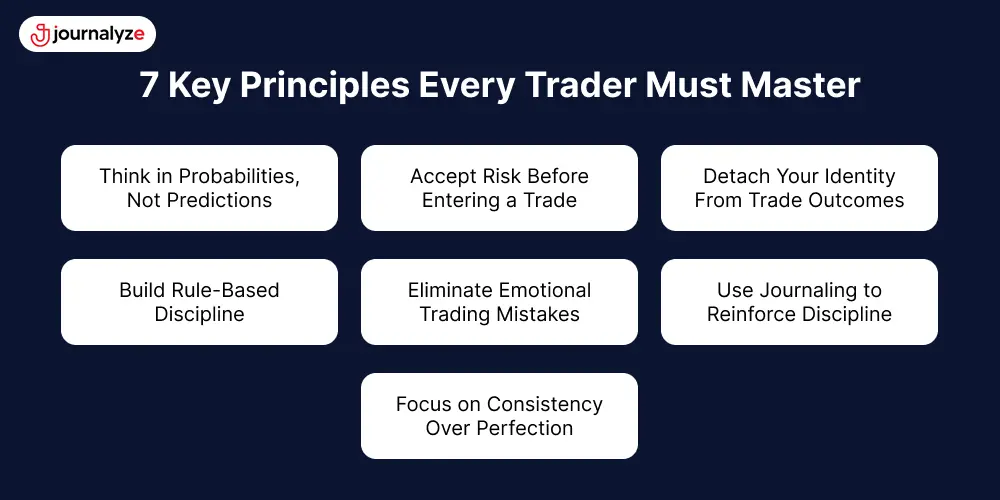
7 Key Principles Every Trader Must Master
1. Think in Probabilities, Not Predictions
Probabilistic thinking is one of the strongest ideas that Mark Douglas shared.
There are no guaranteed winning trades.
Professional traders understand that
- Every trade outcome is uncertain.
- Edge plays out over a series of trades
- Losses are part of the business.
Example
It's possible to have 5 losing streaks in a row with a strategy that has a 60% win rate.
Traders with emotional traits sell when they lose money.
Traders who trade regularly know about the odds.
2. Accept Risk Before Entering a Trade
Most of the emotional blunders occur because traders have not completely taken on the risk in advance.
Before entering a trade, traders should define:
- Entry
- Stop loss
- Position size
- Maximum acceptable loss
- Profit target
This leads to:
- Better decision-making
- Reduced panic exits
- Improved consistency
3. Detach Your Identity From Trade Outcomes
Many traders think of losing trades as a failure.
This results in emotional disturbances.
Professional traders understand:
If you are losing a trade, it doesn't mean that you are a bad trader.
It just means that in one case, probabilities were realized in a different manner.
A trader who detaches his ego from the outcomes keeps all his trading objectives.
4. Build Rule-Based Discipline
Discipline does not lead to motivation.
It is the capacity to act according to fixed rules, in spite of emotional reactions.
Strong trading discipline includes:
- Following entry criteria
- Respecting stop losses
- Maintaining position sizing rules
- Avoiding impulsive trades
- Sticking to trading sessions
5. Eliminate Emotional Trading Mistakes
A lack of consistency is caused by emotional trading.
The most typical emotional errors that traders make are:
| Emotional Mistake | Impact on Trading |
| Revenge trading | Overtrading and losses |
| Fear of missing out (FOMO) | Poor entries |
| Moving stop losses | Increased risk |
| Overleveraging | Account instability |
| Exiting winners early | Reduced profitability |
| Ignoring trading plans | Inconsistent results |
It is important to identify these actions quickly if you want to be successful in the long run.
6. Use Journaling to Reinforce Discipline
One of the most underrated trading psychology tools is a trading journal.
Journaling allows traders to recognize the following:
- Emotional triggers
- Repeated mistakes
- Best-performing setups
- Risk management issues
- Execution consistency
- Win rate analysis
- Risk-to-reward tracking
- Behavioral analytics
- Session performance
- Strategy optimization
Emotional Trader vs Systematic Trader
| Emotional Trader | Systematic Trader |
| Trades based on feelings | Trades based on rules |
| Chases the market | Waits for setups |
| Moves stop losses | Respects risk parameters |
| Panics during losses | Accepts statistical variance |
| Focuses on single trades | Focuses on long-term edge |
| Overtrades frequently | Executes selectively |
| Reacts emotionally | Thinks probabilistically |
7. Focus on Consistency Over Perfection
Perfectionism is dangerous in trading.
Even the best traders lose trades regularly.
The goal is not to avoid losses.
The goal is to:
- Follow the process
- Manage risk
- Maintain emotional stability
- Execute consistently
Read More: 7 Trading Mistakes Data Can Reveal
Probabilistic Thinking Explained
Probabilistic thinking is the awareness that the outcome of a trade is not certain, but rather follows a distribution of probabilities.
Successful traders have the mind of the casino operators.
Casinos aren't concerned about individual results, as they believe in the benefit from many events.
Traders should take the same tactic towards the market.
Probabilistic thinking has the following benefits:
- Reduces emotional stress
- Improves discipline
- Prevents overreaction
- Encourages long-term consistency
- Enhances risk management
Trading Psychology Checklist
Before each trading session, make sure to use this checklist:
Pre-Trade Checklist
- Defined entry criteria
- Stop loss placed
- Position size calculated
- Risk accepted fully
- No emotional bias
- Following a trading plan
During Trade
- No moving stop losses
- No impulsive exits
- Avoid checking P&L constantly
- Stay process-focused
Post-Trade Review
- Journal the trade
- Record emotional state
- Analyze execution quality
- Identify mistakes objectively
How Trading Journals Improve Long-Term Performance
Structured journal turns trading from random guesses into quantifiable performance improvement.
Benefits include:
- Pattern recognition
- Better emotional awareness
- Reduced impulsive behavior
- Strategy refinement
- Improved accountability
Conclusion
Lessons from Trading in the Zone are extremely applicable today, as markets test traders' emotions on a daily basis.
It's not just about the technical knowledge.
Long-term successful traders are those who:
- Think probabilistically
- Manage emotions effectively
- Accept losses professionally
- Execute consistently
- Maintain disciplined routines
With a combination of structured discipline, an awareness of emotions, and tools such as day trading journal software and day trading analytics software, traders can develop a repeatable system that can pave the path to long-term success.
Frequently Asked Questions (FAQ)
What is Trading in the Zone about?
Trading in the Zone is about trading psychology, emotional discipline, risk management, and probabilistic thinking that are necessary to be a consistent trader.
Who is Mark Douglas?
Mark Douglas was a highly regarded trading psychology expert who taught traders how to cultivate a disciplined and calm approach to trading.
What is probabilistic thinking in trading?
Probabilistic thinking is the ability to realize that there is no assured result when trading. Traders tend to pay more attention to the statistics of trades as opposed to each trade.
Why is trading psychology important?
Trading psychology impacts decision-making, discipline, and risk management. Emotional errors frequently cause erratic trading results, even with the help of profitable trading strategies.
How does a trading journal help traders?
A trading journal records performance, emotional behavior, frequent errors, and execution quality. It enhances accountability and continuity.
What is the best day trading journal software?
The best day trading journal software will vary based on the different trading styles, analytics, and automation needs. Advanced platforms have features for strategy optimization, performance tracking, and behavioral analytics.
How can day trading analytics software improve trading performance?
Day trading analytics tools provide traders with measurable data insights that can be used to analyze the trader's win rate, risk management, trading patterns, emotional triggers, and trading strategy performance.