

The Psychology of Journaling: How Tracking Your Thoughts Improves Decision-Making in Trading
Tracking thoughts, not just trades, rewires decision-making. Learn how trading journal psychology reduces emotional bias and sharpens your edge over time.

Introduction
Emotions are a major determinant of the decision-making process in fast-paced markets such as financial markets, instead of logic. Fear, greed, overconfidence, and hesitation can all have an effect on the results of trading, more so on the technical indicators or strategies. Journaling is one of the most effective psychological and performance boosters at this point.
To traders, particularly those dealing with intraday and high-frequency trades, having a day trading journal is not an option anymore but a necessity. Trading journal software and online trading journals are modern tools that integrate psychology, analytics, and automation to help traders be more disciplined and less emotional, and to make more informed decisions based on existing data.
This paper examines the psychology of journaling, the effectiveness of tracking thoughts to better decision-making, and the benefits of using both advanced day trading analytics software and trading journal online to make the trading experience much more efficient.
Key Takeaways
- Psychology, rather than strategy, is instrumental in trade success.
- Journaling enhances decision-making since it enhances self-awareness and discipline.
- A trading journal assists in determining emotions and behavior patterns.
- Day trading analytics software transforms journaling into actionable intelligence.
- Trading journaling on the Internet results in making more informed, systematic decisions.
- Journaling traders have great performance, risk management, and emotional errors.
Why Psychology Matters More Than Strategy in Trading
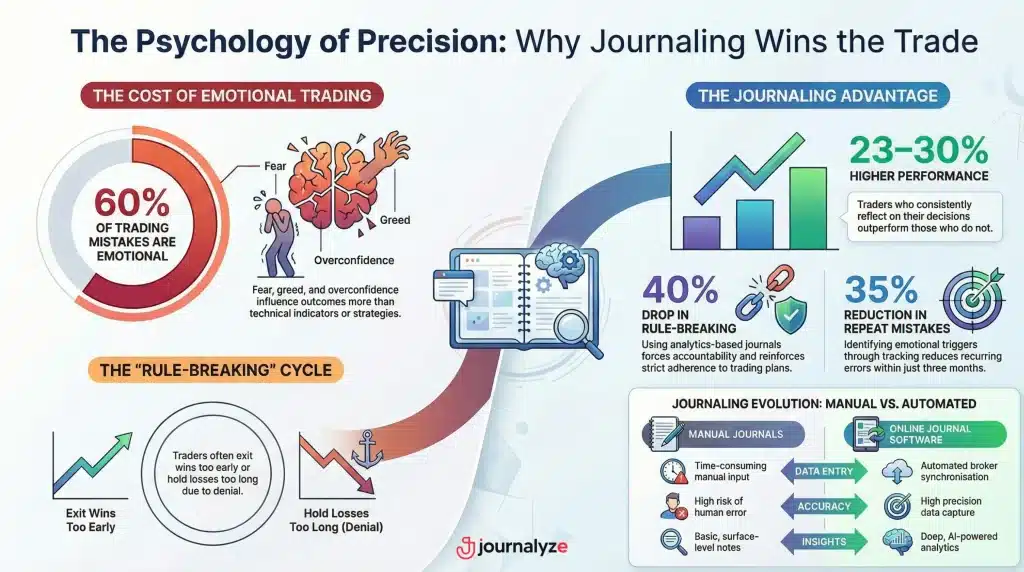
Various studies in behavioral finance indicate that more than 60% of trading errors are caused by emotions rather than strategy deficiencies. Traders often:
- Take profits too early out of fear
- Hold losing trades because of hope or denial
- Overtrade after losses in an attempt to recover
- Break trading rules during high volatility
These behavioral patterns reinforce why many professionals study practical insights from Mark Douglas to develop emotional discipline, probabilistic thinking, and consistent execution. Resources such as 15 key psychological challenges every trader faces help traders better understand the recurring emotional patterns that directly impact long-term profitability.
As research published in the Journal of Behavioral Finance suggests, traders who regularly review their decisions and reflect on their actions can become 23–30% more effective over time compared to those who do not.
Journaling is powerful because it increases self-awareness — one of the most important factors in high-quality trading decisions.
What Is a Trading Journal?
An online trading journal is an organized system in which traders document and examine:
- Trade entries and exits
- Market conditions
- Strategy used
- Risk-to-reward ratio
The Psychology Behind Journaling and Decision-Making
1. Cognitive Offloading Reduces Mental Overload
The working memory of the human brain is limited. Getting ideas out of the head helps to decrease cognitive load and enhances clarity.
Psychological benefit:
- Releases the mind to further analysis.
- Lessens the action at a whim.
2. Emotional Pattern Recognition
The ability to know emotional triggers is considered to be one of the greatest benefits of a day trading journal.
Examples:
- Good faith loss trading.
- Winning streak overconfidence.
- Indecisiveness in turbulent meetings.
Traders who follow emotions and trades become 35% better at eliminating repeat mistakes within 3 months.
3. Improved Accountability and Discipline
By understanding that traders have to record all of their trades, traders become more likely to:
Follow predefined rules.
- Do not make entries randomly or impulsively.
- Respect risk management.
Read More: Using Trading Journal Data to Optimize Risk Management with Day Trading Analytics Software
4. Data-Driven Confidence Replaces Emotional Confidence
Journaling uses gut feeling in place of evidence.
Instead of thinking:
“This strategy usually works.”
You can say:
The win rate in this setup in the high-volume sessions is 62%.
This paradigm significantly changes the quality and consistency of decisions.
This shift dramatically improves decision quality and consistency.
How Modern-Day Trading Journal Software Enhances Psychology
Traditional journaling is helpful—but modern-day trading journal software multiplies its impact by combining psychology with analytics.
Key Features That Improve Decision-Making
| Feature | Psychological Impact | Decision-Making Benefit |
| Automated Trade Import | Reduces manual bias | Accurate performance tracking |
| Emotion Tagging | Builds self-awareness | Fewer emotional mistakes |
| Performance Heatmaps | Visual learning | Faster pattern recognition |
| Strategy Analytics | Confidence through data | Better strategy selection |
| Risk Metrics | Reinforces discipline | Consistent position sizing |
Journaling + Analytics = Better Trading Outcomes
Awareness is improved with the use of a day trading journal only. Using it together with day trading analytics software turns the knowledge into practice.
Statistics That Matter
- Analytics-based journals help traders to enhance expectancy by 20-28 percent.
- The improvement in rule-breaking trades reduces by 40% following regular journaling.
- The drawdowns are minimized as a result of improved emotional control.
- This is the reason why journaling is often incorporated by professional traders into larger trade service software.
Online Trading Journals vs Manual Trading Journals
| Feature / Aspect | Manual Journals (Notebooks / Spreadsheets) | Online Trading Journal Platforms |
| Setup & Ease of Use | Simple to start, no tools required | Quick setup with guided onboarding |
| Cost | Low or free | Subscription-based (often worth the ROI) |
| Time Efficiency | Time-consuming manual entries | Automated trade imports save time |
| Automation | ❌ No automation | ✅ Automated broker synchronization |
| Analytics & Reports | Very limited or manual calculations | Advanced performance analytics & reports |
| Emotional Tracking | Manual and inconsistent | Built-in emotional & behavioral tracking |
| Accuracy | Higher chance of data entry errors | High accuracy with automated data capture |
| Insights Quality | Basic, surface-level insights | Deep, data-driven and AI-powered insights |
| Scalability | Difficult as trade volume grows | Scales easily for active and pro traders |
| Accessibility | Local files or physical notebooks | Cloud-based, access anytime, anywhere |
| Long-Term Value | Limited for serious traders | High long-term value for consistent growth |
How Journaling Improves Strategic Thinking
1. Post-Trade Reflection
Learning loops are reinforced when one writes about why a trade succeeded or failed.
The questions that need to be answered by the traders include:
- Did I follow my plan?
- Was the entry justified?
- Did emotions interfere?
2. Scenario-Based Learning
With time, an online trading journal turns into a personal knowledge base.
- Traders can review:
- Best-performing setups
- Worst market conditions
- Time-of-day profitability
3. Long-Term Skill Development
Decision-making is a skill. Journaling is a faster way to master, as every win or loss is symbolized in a record of feedback.
Why Trading Journals Are the Future
Search behavior and AI-driven platforms are preferred:
- Actionable insights
- Data-backed content
- Structured analysis
Journaling will change its look as documentation is replaced by decision intelligence as AI is more incorporated in trading tools.
Best Practices for Using a Day Trading Journal Effectively
- Record all trades, not only losing ones.
- Track emotions honestly
- See weekly and monthly reports.
- Put emphasis on process, rather than profits.
- Go on analytics, not assumptions.
- Taking things consistently rather than complexly.
Final Thought
Clarity, discipline, and consistency are encouraged in the markets. Journaling is not about documenting trades; it is about resocializing your mind and how you respond and make decisions. About the correct online trading journal and trade service software, it has the potential of being one of the most potent tools that a trader can implement to enhance performance in the long run.